Table Of Content

With the help of the product leaders, the company board will turn the objectives into initiatives that solve multiple problems. The initiative should also be paired with one or more objectives to track progress. Bottom–up control in ecosystems refers to ecosystems in which the nutrient supply, productivity, and type of primary producers (plants and phytoplankton) control the ecosystem structure.
More of a strain on leadership
They then communicate them to the lower levels of the organization, who are expected to follow them without much input or feedback. Bottom-up integration testing is a testing procedure in which low-level modules are merged into clusters (builds), and then the drivers are developed after the build is reviewed. This testing method is also known as “testing from the bottom up.” At long last, drivers have been eliminated, and we’ve begun integrating builds as we progress higher in the program. This testing gives a high deployment coverage in the early stages of software development. While a bottom-up approach allows decisions to be made by the same people who are working directly on a project, the top-down style of management creates distance between that team and decision-makers.
ALL PLANS
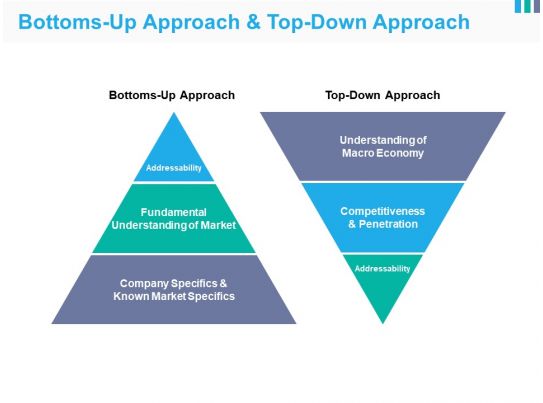
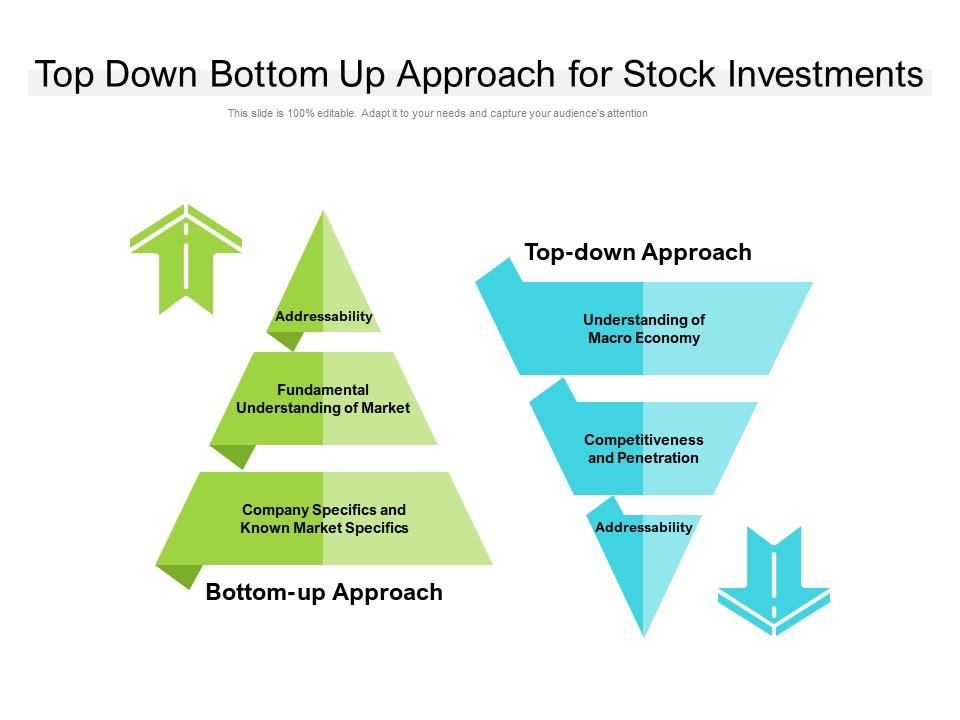
ArXiv is committed to these values and only works with partners that adhere to them. A top-down approach is more generalized, and so may miss out on a number of potentially good opportunities by eliminating specific companies that don't fall into its criteria. Most often, bottom-up investors are buy-and-hold investors who have a deep understanding of a company's fundamentals. Top-down analysis generally refers to using comprehensive factors as a basis for decision-making. The top-down approach seeks to identify the big picture and all of its components.
More room for creativity
Each part again goes through the top-down approach till the complete system is designed with all the minute details. TopDown approach is also termed as breaking a bigger problem into smaller problems and solving them individually in recursive manner. For a design project where considerable information exists e.g. from the experience of a similar project, top-down approach has a clear advantage. The existing information can be captured and placed at a central location to start a project and distribute the tasks to team members. Funds like the AAM S&P 500 High Dividend Value ETF (SPDV) and the Schwab Fundamental U.S. Large Company Index ETF (FNDX) focus on specific fundamental bottom-up attributes that are expected to be key performance drivers.
bottom-up Business English
To strike a balance in your management style, adherence to the best practices for merging both approaches is important. To better understand the practical implications of top-down and bottom-up approaches, it is helpful to explore real-life examples from various industries and organizations. These examples showcase how different management styles can impact decision-making, employee engagement, and overall performance. The top-down approach basically divides a complex problem or algorithm into multiple smaller parts (modules). These modules are further decomposed until the resulting module is the fundamental program essentially be understood and can not be further decomposed. After achieving a certain level of modularity, the decomposition of modules is ceased.
While the two schemes are common terms, many investors get them confused or don't fully understand the differences between the approaches. The primary application of the bottom-up approach is testing as each fundamental module is first tested before merging it to the bigger one. Join over thousands of organizations that use Creately to brainstorm, plan, analyze, and execute their projects successfully. The top-down approach is based on the assumption that the leaders have the best knowledge and vision of the organization and its environment.
Management and organization
They are required to find the best investments using a fundamental approach that identifies the companies with the best fundamental ratios or industry-leading attributes. They would then investigate those stocks in regard to macro and global influences. Investment management firms and investment managers can focus an entire investment strategy on top-down management that identifies investment trading opportunities purely based on top-down macroeconomic variables. These funds can have a global or domestic focus, which also increases the complexity of the scope. Top-down and bottom-up approaches are methods used to analyze and choose securities. However, the terms also appear in many other areas of business, finance, investing, and economics.
Bottom Up Pricing & Packaging: Let the User Journey Be Your Guide - Andreessen Horowitz
Bottom Up Pricing & Packaging: Let the User Journey Be Your Guide.
Posted: Thu, 11 Mar 2021 08:00:00 GMT [source]
What are some key principles to keep in mind when adopting Bottom-Up Design?
In Top-down Model, the focus is on breaking the bigger problem into smaller one and then repeat the process with each problem. Read this article to find out more about the bottom-up model and the top-down model of system design and how they are different from each other. In System Design, there are two types of approaches followed namely, the Bottom-Up Model and the Top-Down Model. If very little or no information exists about a new product, it becomes meaningless to start with top-down approach.
Later, the programming team looks at the requirements of each of those functions and the process is repeated. These compartmentalized subroutines eventually will perform actions so simple they can be easily and concisely coded. When all the various subroutines have been coded the program is ready for testing. By defining how the application comes together at a high level, lower-level work can be self-contained.
In this blog post, we will explain what these two approaches are, how they work, and what are their pros and cons. We will also give you some tips on when to use each approach and how to balance them. Top–down reasoning in ethics is when the reasoner starts from abstract universalizable principles and then reasons down them to particular situations. Finally, wired everything together in demonstrate_bottom_up, which is like the grand finale at a fireworks show. It sequentially illustrates the output of our basic, intermediate, and complex operations using a sample input, consequently revealing the magical crescendo of Bottom–Up design.
From simple task management and project planning to complex resource and portfolio management, Smartsheet helps you improve collaboration and increase work velocity -- empowering you to get more done. This leadership style allows for communication and continued fluidity as they are able to consider a greater number of opinions when making decisions. Rather than having a singular, overarching leader responsible for decision making, ideas are exchanged across a widespread group. Companies utilize the top-down approach in order to assess, determine, and implement business decisions made by upper executives. The company should have already invested in the voice-of-customer (VOC) initiative or built a strategy for continuous customer feedback.
A third difference is the type of culture and environment that each approach creates. In top-down approach, the culture and environment are more formal, hierarchical, and centralized. In bottom-up approach, the culture and environment are more informal, flat, and decentralized. They are expected to follow orders and instructions without questioning or challenging them. They are expected to contribute ideas and opinions and take initiative in their work. The main difference between top-down and bottom-up approaches is the direction of the flow of communication and decision-making.
Object-oriented programming (OOP) is a paradigm that uses "objects" to design applications and computer programs. Top–down design was promoted in the 1970s by IBM researchers Harlan Mills and Niklaus Wirth. Mills developed structured programming concepts for practical use and tested them in a 1969 project to automate the New York Times morgue index.
Bottom-up communication is sometimes referred to as the seed model, as small ideas from each employee grow into complex, organic goals that lead to eventual successes. In a sense, there is a merging of employees and each of their roles into a broader focus dealing with the entire company. This forward-looking approach considers each aspect of a company by taking in the respective employees’ inputs to make a better decision for the entire company. The top-down approach relies on higher authority figures to determine larger goals that will filter down to the tasks of lower level employees.
In other words, an algorithm is used to perform the operations on the data inside the data structures. The key is to understand your goals, objectives, strategies, resources, challenges, opportunities, strengths, weaknesses, culture, values, leaders, employees, customers, competitors, stakeholders, environment, etc. For the purpose of this testing, drivers, which are transient modules used for integration testing, are used as testing aids for the program. The approach from the bottom up is diametrically opposed to the approach from the top down.
By balancing between both, the product manager can align the high-level goals passed from the executives with the customer needs to prioritize their product backlogs. After determining the set of features that the company wants to deliver within a certain timeframe, the product leaders will negotiate the product roadmap with the company board, finalize it, and communicate it with the company. Oftentimes, the company’s board has a vision that states the (ideal) future of the company and clarifies the business purpose. However, the vision is only the first step in the puzzle — it’s quite wide and hard to execute. This one’s the showstopper; it stands on the shoulders of the intermediate_operation, getting the result and then raising it to the power of 2. Another important difference between the two is that the top-down model is mainly used in structural programming like C programming, whereas the bottom-up approach is followed in object-oriented programming like C++, Java, etc.


No comments:
Post a Comment